
Politics
Political Exchange Intensifies as BJP Leaders Criticise DMK Over Allegations and Representation Debate
BJP leaders Piyush Goyal and Amit Shah criticise DMK leadership amid allegations and political tensions in Tamil Nadu, sparking debate over governance.


Political Exchange Intensifies as BJP Leaders Criticise DMK Over Allegations and Representation Debate
Last Updated: April 17, 2026
A political confrontation between leaders of the Bharatiya Janata Party (BJP) and the ruling Dravida Munnetra Kazhagam (DMK) in Tamil Nadu intensified on Friday, following public remarks by Union Minister Piyush Goyal and Union Home Minister Amit Shah. The statements come amid reports of an alleged harassment incident near a coaching centre, prompting calls for swift administrative action and further fuelling the ongoing political debate in the state.
According to initial information, officials have been directed to identify the suspect involved in the alleged incident and take immediate action. Authorities have not yet released detailed findings, and the investigation remains ongoing. The matter has drawn attention due to its timing, coinciding with heightened political exchanges between the Centre and the Tamil Nadu government.
BJP Leaders Raise Concerns Over Governance
Union Minister Piyush Goyal, in a post on social media platform X, criticised Tamil Nadu Chief Minister M. K. Stalin, accusing him of engaging in what he described as “fear-based politics.” Goyal alleged that misinformation was being used as a political tool and claimed that such tactics were becoming increasingly visible to the public.
While these statements reflect the BJP’s position, the DMK has not issued an immediate response to the specific allegations at the time of publication. Political observers note that such exchanges are not uncommon in the current climate, especially ahead of key political developments in the state.
Assembly Representation Debate Adds to Tensions
Separately, Union Home Minister Amit Shah addressed concerns related to Tamil Nadu’s representation in legislative structures. He stated that the state’s representation percentage currently stands at 7.18% and is expected to rise marginally to 7.23%, asserting that there would be no loss to Tamil Nadu in terms of representation.
The remarks were made in response to ongoing debates around delimitation and political representation, an issue that has sparked discussion across several southern states. Critics have expressed concerns over potential shifts in representation, while the Centre has maintained that no state would face disadvantage under the proposed framework.
- Current representation: 7.18%
- Projected increase: 7.23%
- Centre’s stance: No reduction in Tamil Nadu’s representation
Background: Centre-State Political Friction
The latest developments come against the backdrop of a broader political contest between the BJP-led central government and DMK-led Tamil Nadu administration. Differences have emerged on issues ranging from governance approaches to federal policies.
The DMK, a key regional party, has often positioned itself in opposition to central policies, particularly on matters related to language, education, and state autonomy. Meanwhile, BJP leaders have frequently criticised the state government’s handling of law and order and administrative matters.
[Read more: Tamil Nadu political developments and Centre-state relations]
Alleged Incident Sparks Administrative Response
The reported harassment incident near a coaching centre has added urgency to the situation. Officials have been instructed to conduct a thorough investigation and ensure accountability. Law enforcement agencies are expected to provide updates once preliminary findings are confirmed.
Authorities have emphasised that due process will be followed and cautioned against drawing conclusions before the investigation is complete. Public safety and swift justice remain key priorities, according to officials familiar with the matter.
Political Reactions and Public Discourse
The statements by BJP leaders have triggered reactions across political circles, with supporters amplifying the claims on social media under trending hashtags. However, independent analysts stress the importance of distinguishing between political rhetoric and verified facts.
Experts also highlight that social media has become a major platform for political messaging, often shaping public perception even before official confirmations are made. This underscores the need for careful verification and responsible reporting.
[Read more: Impact of social media on Indian political narratives]
Significance and What Lies Ahead
The convergence of a law-and-order issue with political accusations has heightened the stakes in Tamil Nadu’s political landscape. While the investigation into the alleged incident continues, the broader debate around governance, representation, and political accountability is expected to persist.
The coming days may see formal responses from the DMK and further clarification from authorities regarding the incident. Political analysts suggest that such developments could influence public discourse, especially as parties prepare for future electoral contests.
FAQ
What is the alleged incident mentioned in the reports?
An alleged harassment incident near a coaching centre has been reported, and officials have been asked to identify the suspect and take action. The investigation is ongoing.
What did Piyush Goyal say about the DMK?
Piyush Goyal criticised the Tamil Nadu government, accusing it of engaging in fear-based politics and spreading misinformation. These are political claims and have not been independently verified.
What is the representation issue raised by Amit Shah?
Amit Shah stated that Tamil Nadu’s representation would slightly increase from 7.18% to 7.23%, asserting that the state would not face any loss in representation.
Has the DMK responded to these allegations?
As of now, there has been no official response from the DMK regarding the specific remarks made by BJP leaders in this instance.




Politics
Assam’s Development Narrative Gains Momentum Under Chief Minister Himanta Biswa Sarma
Assam’s growth story under CM Himanta Biswa Sarma highlights infrastructure, welfare schemes, and political debates shaping the state’s development path.

Assam’s Development Narrative Gains Momentum Under Chief Minister Himanta Biswa Sarma
Last Updated: April 7, 2026 | 02:19 PM IST
Assam’s development trajectory under Chief Minister Himanta Biswa Sarma has become a focal point of both governance discussions and political debate, with recent social media trends highlighting achievements, welfare initiatives, and criticism from opposition leaders. The developments matter as they reflect the evolving political and economic landscape of the northeastern state.
The phrase “Assam Rising With Himanta” has gained traction online, with supporters citing infrastructure growth, rural connectivity, and welfare schemes as key indicators of progress. At the same time, political exchanges between leaders from the ruling party and opposition have added a layer of controversy to the narrative.
Infrastructure Push and Rural Connectivity
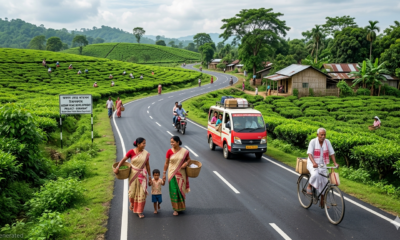
One of the key claims highlighted in the recent discourse is Assam’s expansion of rural road networks under the Pradhan Mantri Gram Sadak Yojana (PMGSY). According to official figures shared by supporters, the state has constructed thousands of roads, improving connectivity in remote regions.
- Over 9,000 roads reportedly built under PMGSY
- Enhanced access to villages and rural markets
- Improved mobility for education and healthcare services
Infrastructure development has been positioned as a cornerstone of the state government’s strategy to boost economic growth and integrate rural areas more effectively into the broader economy.
Focus on Welfare: Orunodoi 3.0 Scheme
The government has also emphasized social welfare, particularly through the Orunodoi 3.0 scheme. Chief Minister Sarma has described the initiative as a step toward empowering women and strengthening household incomes.
With a reported budget allocation of ₹3,645 crore, the scheme aims to provide direct financial assistance to eligible families, with a focus on women beneficiaries. Officials argue that the initiative goes beyond financial aid by promoting dignity and socio-economic independence.
Supporters highlight that such programs are crucial in addressing poverty and inequality in the region. [Internal Link Placeholder: Read more on central government welfare schemes]
Political Exchanges and Opposition Criticism
Amid the development narrative, political tensions have surfaced. Statements from Congress leaders, including remarks attributed to Pawan Khera and Mallikarjun Kharge, have sparked debate.
Kharge, addressing questions related to legal actions involving party members, reportedly commented that such cases are not uncommon and should proceed as per due process. Meanwhile, criticism directed at the language used in political discourse has drawn reactions from both sides.
The exchanges underline the broader political contest between the Bharatiya Janata Party (BJP) and the Congress, especially as both parties seek to shape public perception ahead of future electoral contests.
Public Sentiment and Social Media Trends
The hashtag “Assam Rising With Himanta” has seen significant engagement, reflecting a mix of public support and partisan messaging. Social media posts have praised leadership decisions, governance style, and development initiatives.
However, analysts note that such trends often represent a segment of opinion rather than a comprehensive picture of public sentiment. Independent assessments and on-ground data remain critical for evaluating governance outcomes.
[Internal Link Placeholder: Analysis of social media trends in Indian politics]
Background: Assam’s Development Challenges
Assam has historically faced challenges related to infrastructure gaps, flood management, and socio-economic disparities. Successive governments have attempted to address these issues through a combination of central and state-level initiatives.
The current administration has placed emphasis on:
- Connectivity and infrastructure development
- Welfare schemes targeting vulnerable groups
- Administrative reforms and governance efficiency
These efforts are part of a broader strategy to position Assam as a key growth hub in the Northeast.
Impact and Significance
The ongoing narrative around Assam’s development has implications beyond the state. It highlights the role of regional leadership in driving policy implementation and shaping political discourse.
Key impacts include:
- Improved rural connectivity supporting local economies
- Increased focus on women-centric welfare programs
- Heightened political engagement and debate
While supporters credit the government for tangible progress, critics emphasize the need for transparent data, inclusive growth, and balanced development across regions.
FAQ
What is the “Assam Rising With Himanta” trend?
It is a social media narrative highlighting development initiatives and governance under Chief Minister Himanta Biswa Sarma, along with political discussions surrounding them.
What is Orunodoi 3.0?
Orunodoi 3.0 is a welfare scheme aimed at providing financial assistance to families in Assam, with a focus on empowering women beneficiaries.
How has infrastructure development progressed in Assam?
The state has expanded rural connectivity through road construction under schemes like PMGSY, improving access to essential services.
What are the key political issues involved?
Recent debates include opposition criticism, legal cases involving political figures, and broader discussions on governance and public discourse.
Politics
Mumbai Metro Expansion: Devendra Fadnavis Inaugurates Key Projects to Boost Connectivity
Devendra Fadnavis inaugurates Mumbai Metro Line 9 phase and announces major infrastructure projects to enhance connectivity and urban mobility.

Mumbai Metro Expansion: Devendra Fadnavis Inaugurates Key Projects to Boost Connectivity
Last Updated: April 7, 2026
Maharashtra Chief Minister Devendra Fadnavis on Tuesday inaugurated a key phase of Mumbai Metro Line 9 in Dahisar, marking a significant milestone in the city’s expanding urban transport network. The event, held at 1:02 PM in Dahisar, Mumbai, highlighted multiple infrastructure developments aimed at improving connectivity across the Mumbai Metropolitan Region (MMR). The projects are expected to enhance mobility, reduce travel time, and support economic growth.
Metro Line 9 Phase 1 Inaugurated
The newly launched section of Metro Line 9 connects Dahisar (East) to Kashigaon in its first phase. The corridor includes four important stations:
- Dahisar East
- Pandurangwadi
- Miragaon
- Kashigaon
Officials stated that this stretch will significantly ease congestion on existing road networks and provide a faster commuting option for residents in the northern suburbs and neighbouring Thane region.
The inauguration ceremony was attended by senior officials of the Mumbai Metropolitan Region Development Authority (MMRDA), along with local representatives.
Push for ‘Mumbai in Minutes’ Vision
The metro expansion forms part of the broader ‘Mumbai in Minutes’ vision, which aims to drastically reduce travel times across the city. According to the state government, integrated metro corridors and infrastructure upgrades will help achieve faster point-to-point connectivity.
Chief Minister Fadnavis emphasized that projects like Metro Line 9 and the upcoming Metro Line 2B will make commuting smoother, safer, and more efficient for Mumbaikars.
The Metro Line 2B corridor, currently under development, is expected to further strengthen east-west connectivity, linking key residential and commercial hubs.
Additional Infrastructure Projects Announced
In addition to the metro inauguration, the state government highlighted several major infrastructure initiatives that are expected to reshape urban mobility in the region:
- Thane-Borivali Twin Tunnel: A proposed underground corridor aimed at drastically cutting travel time between Thane and Borivali.
- Pod Taxi System: A futuristic transport solution being explored to improve last-mile connectivity.
- Expanded Metro Network: Continued development of multiple metro lines to create an integrated transport grid.
These projects are expected to boost trade, improve access to education and healthcare, and support overall economic development.
Impact on Commuters and Economy
Urban planners and officials believe that improved connectivity between Thane, Borivali, and other suburban regions will unlock new economic opportunities. Reduced travel times can lead to increased productivity, better job accessibility, and enhanced quality of life.
Commuters are likely to benefit from:
- Shorter travel durations
- Reduced traffic congestion
- Safer and more reliable transport options
The integration of metro corridors is also expected to reduce dependence on private vehicles, contributing to lower emissions and a greener urban environment.
Background: Mumbai’s Expanding Metro Network
Mumbai has been rapidly expanding its metro network over the past decade to address growing population pressures and traffic congestion. The MMRDA has been spearheading multiple metro projects, with several lines already operational and others under construction.
The Metro Line 9 corridor is an extension of the existing network and plays a crucial role in connecting suburban areas with key transit hubs.
[Read more on Mumbai infrastructure projects]
[Explore latest India news updates]
Political and Public Reactions
While the inauguration has been widely welcomed as a step forward in urban development, infrastructure projects in Mumbai have historically faced debates over environmental concerns and land acquisition. Some critics have previously raised issues regarding ecological impact, while the government has maintained that sustainable practices are being followed.
Supporters of the project have credited the state leadership for accelerating infrastructure development and delivering long-pending projects.
Looking Ahead
With multiple metro lines nearing completion and new projects in the pipeline, Mumbai’s transport landscape is set for a major transformation. Authorities aim to create a seamless, multi-modal transport system that can support the city’s long-term growth.
The successful execution of these projects will be critical in determining how effectively Mumbai can meet its future mobility needs.
FAQs
What is Metro Line 9 in Mumbai?
Metro Line 9 is a suburban metro corridor connecting Dahisar East to Kashigaon, designed to improve connectivity in northern Mumbai and nearby regions.
Which stations are included in the first phase?
The first phase includes Dahisar East, Pandurangwadi, Miragaon, and Kashigaon stations.
What is the ‘Mumbai in Minutes’ vision?
It is a government initiative aimed at reducing travel time across Mumbai through integrated infrastructure and transport projects.
How will these projects benefit commuters?
They will provide faster, safer, and more reliable travel options while reducing congestion and improving connectivity.
Politics
Parliament Budget Session: Rajya Sabha passes Amaravati capital Bill; Lok Sabha debates CAPF Bill
Rajya Sabha passes Amaravati capital Bill while Lok Sabha debates CAPF Bill amid Opposition concerns during Parliament Budget Session.

Parliament Budget Session: Rajya Sabha passes Amaravati capital Bill; Lok Sabha debates CAPF Bill
Last Updated: April 2, 2026, 4:10 PM IST
Parliament witnessed significant legislative activity on Thursday during the ongoing Budget Session, with the Rajya Sabha passing the Andhra Pradesh Reorganisation (Amendment) Bill, 2026, to designate Amaravati as the permanent capital of the State, while the Lok Sabha took up discussions on the Central Armed Police Forces (General Administration) Bill, 2026. The developments are seen as crucial for both administrative reforms and federal governance.
Rajya Sabha clears Amaravati as Andhra Pradesh capital
The Rajya Sabha passed the Andhra Pradesh Reorganisation (Amendment) Bill, 2026, through a voice vote amid sloganeering by Opposition members. The Bill seeks to formally establish Amaravati as the permanent capital of Andhra Pradesh, a long-debated issue since the State’s bifurcation in 2014.
Chairing the session, the Vice President congratulated the people of Andhra Pradesh following the passage of the Bill. Government representatives described the move as a step towards administrative clarity and long-term development.
Union Minister Kinjarapu Rammohan Naidu said the legislation would bring stability and direction to the State, adding that uncertainty over the capital had hindered growth. He also acknowledged the contribution of farmers who had pooled land for the Amaravati project.
However, Opposition leaders raised concerns about the timing and intent of the legislation.
- Congress MP Jairam Ramesh accused the government of rushing Bills for political gains ahead of elections.
- YSRCP MP Y.V. Subba Reddy opposed the Bill, citing unresolved compensation issues for farmers.
- Renuka Chowdhury termed the prolonged delay in resolving the capital issue a “national shame.”
Despite objections, the government maintained that the decision reflects the aspirations of the people and aligns with development goals.
Lok Sabha debates CAPF Bill amid sharp exchanges
In the Lok Sabha, members debated the Central Armed Police Forces (General Administration) Bill, 2026, which was earlier passed by the Rajya Sabha. The Bill proposes significant changes in the appointment structure within CAPFs.
Key provisions include:
- 50% of Inspector General-level posts to be filled through deputation
- At least 67% of Additional Director General posts to be filled through deputation
- All Special Director General and Director General posts to be filled through deputation
The Bill was introduced in the absence of the Union Home Minister, with Minister of State for Home Affairs Nityanand Rai leading the discussion.
Supporters of the Bill argued that deputation of Indian Police Service (IPS) officers would enhance coordination and bring a national perspective to internal security management.
TDP MP Krishna Prasad Tenneti said IPS officers contribute to maintaining a unified administrative approach, which is essential for national security.
Opposition raises concerns over morale and promotions
Opposition members strongly criticised the Bill, arguing that it could negatively impact the morale and career progression of CAPF personnel.
Trinamool Congress MP Mahua Moitra alleged that the government was undermining CAPF officers by limiting their promotional opportunities. She also cited data on suicides among personnel and questioned the structural framework of the forces.
Samajwadi Party MP Dharmendra Yadav demanded that the Bill be referred to a Joint Parliamentary Committee for detailed scrutiny, stating that CAPF personnel often remain in the same rank for years without promotion.
Congress MP Deepender Singh Hooda highlighted the contributions of CAPF personnel in counter-insurgency operations, arguing that their efforts deserve greater recognition and institutional support.
Political exchanges and broader legislative agenda
The proceedings in both Houses were marked by frequent interruptions and political exchanges. In the Rajya Sabha, debates also touched upon the government’s legislative priorities, with Opposition leaders questioning the timing of key Bills.
The government, however, defended its approach, stating that the legislation is aimed at governance reforms and long-pending administrative decisions.
Following the passage of the Amaravati Bill, the Rajya Sabha moved on to discuss the Jan Vishwas Bill, indicating a packed legislative agenda.
Background and significance
The Amaravati capital issue has remained contentious since Andhra Pradesh’s bifurcation, with successive governments adopting different approaches to decentralisation and capital development.
The CAPF Bill, meanwhile, has sparked debate over the balance between centralised control and internal cadre development within paramilitary forces.
Experts note that both measures carry long-term implications:
- The Amaravati decision could influence regional development and political stability in Andhra Pradesh
- The CAPF Bill may reshape leadership structures in India’s internal security forces
For more on parliamentary proceedings, see Parliament Budget Session LIVE Updates and Explained: CAPF Bill controversy.
FAQ
What is the Amaravati capital Bill?
It is an amendment to the Andhra Pradesh Reorganisation Act to officially designate Amaravati as the State’s permanent capital.
What changes does the CAPF Bill propose?
The Bill increases deputation of IPS officers to senior positions in CAPFs, affecting promotion structures within the forces.
Why is the CAPF Bill controversial?
Opposition parties argue it could harm the morale and career growth of CAPF personnel, while the government says it improves coordination.
What happens next in Parliament?
The Lok Sabha will continue debating the CAPF Bill, while the Rajya Sabha proceeds with other legislative business, including the Jan Vishwas Bill.


Samsung Promotes #AwesomeDurability Campaign Highlighting Smartphone Protection Features

Bhooth Bangla Review: Akshay Kumar Returns to Comedy-Horror with Priyadarshan’s Entertaining Blend

Political Exchange Intensifies as BJP Leaders Criticise DMK Over Allegations and Representation Debate

CBI arrests MCD deputy commissioner Abhishek Kumar Mishra in ₹4 lakh bribery case

Andhra Pradesh Budget 2026: ₹3.32 Lakh Crore Mega Outlay Announced, ₹8.3 Crore Earmarked for VB G RAM-G Scheme

T.N. CM Stalin’s Surprise Bonanza: ₹5,000 Credited to Bank Accounts of 1.31 Crore Women Today
-
 India News3 weeks ago
CBI arrests MCD deputy commissioner Abhishek Kumar Mishra in ₹4 lakh bribery case
-
 Politics2 months ago
Andhra Pradesh Budget 2026: ₹3.32 Lakh Crore Mega Outlay Announced, ₹8.3 Crore Earmarked for VB G RAM-G Scheme
-
 Politics2 months ago
T.N. CM Stalin’s Surprise Bonanza: ₹5,000 Credited to Bank Accounts of 1.31 Crore Women Today
-

 Tech1 month ago
Instagram Privacy Shock: Meta to End End-to-End Encryption for Chats After May 2026
-

 India News1 month ago
PM-KISAN 22nd Installment Released: PM Narendra Modi Transfers Funds to Over 9 Crore Farmers from Guwahati
-
 Business2 months ago
Nvidia CEO Jensen Huang Skips India AI Summit Next Week, Company Confirms—What It Means for India’s Tech Ambitions
-

 Sports1 month ago
Kelme India Sparks New Era in Indian Sports: Global Brand’s Entry Signals Big Boost for Athletes and Performance
-

 Politics1 month ago
#नवनिर्माण_के_9वर्ष: From ‘Monk’ to Economic Architect—Yogi Adityanath Sets $1 Trillion Vision for Uttar Pradesh by 2029-30